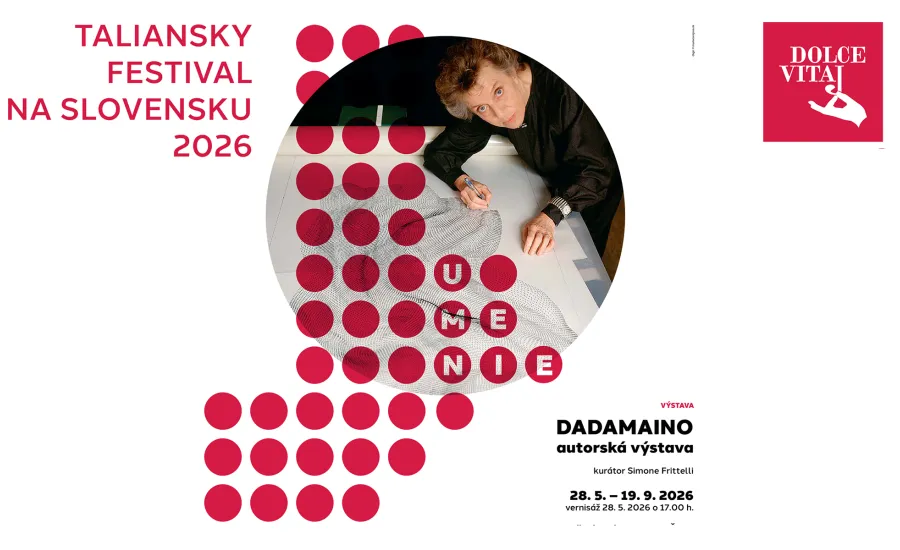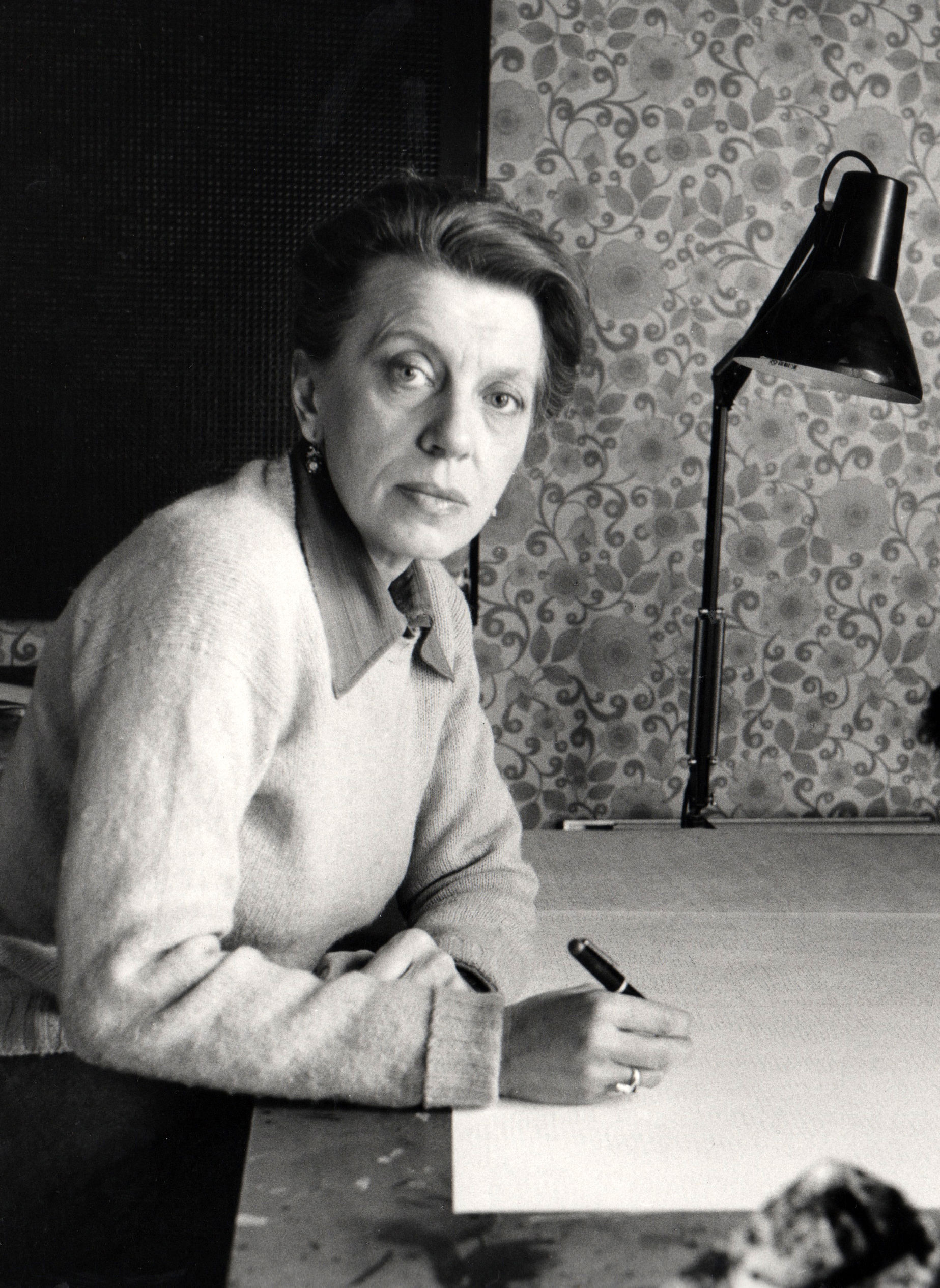
The formation of Eduarda Emilia Maino came within the ambit of the Milanese avant-garde that gathered at the Bar Giamaica in the Brera district: she was particularly close to Piero Manzoni, whom she frequented from 1957, and Lucio Fontana, whom she admired for his radical choices. In his turn, as early as 1959, Fontana showed his faith in her by purchasing one of her works and encouraging her to continue.
Within the artistic milieu she was known as Dada (a diminutive of Eduarda) Maino. Following an early period in which she experimented in the abstract-informal style, towards the end of 1958, influenced by Fontana’s “slashes”, she created her first works of subtraction, subsequently known as Volumi [Volumes], canvases with large elliptical holes that she exhibited for the first time late in 1959, to great scandal, in a group show of women artists from Milan.
She joined the Milanese group Azimuth, exhibiting in various group shows with Manzoni and Castellani and in 1961 she held a solo show at Studio N in Padua, with an introductory text by Manzoni, in which she presented the new series of Volumi a moduli sfasati [Volumes with offset modules], surfaces of a synthetic material in which she punched ever smaller and more numerous holes. This was the beginning of her international adventure conducted via the network of acquaintances of her friend Manzoni: in 1962 she had a solo show at the Galerie Senatore in Stuttgart and was invited, in this case thanks in part to Fontana’s intervention, to participate in the important exhibition Nul at Amsterdam’s Stedelijk Museum alongside protagonists such as Yayoi Kusama, Heinz Mack, Otto Piene, Fontana, Manzoni, Castellani and others. She joined the international New Tendencies movement.
In her works from 1962 and 1963 the artist mainly experimented with aluminium, plastic, Plexiglas and other materials; from then on, she adopted the nom d’art Dadamaino. The works from 1963 to 1965, known as “oggetti” or “objects”, constitute a series of a programmatic nature: model, structure, system, development and evolution through variations. Gillo Dorfles, Umbro Apollonio and Ernesto L. Francalanci took an interest in her work, including the artist among the protagonists of Italian kinetic art.
In parallel with the kinetic period, in 1966 Dadamaino began her Ricerca del colore [Colour research, 1966-68], in which she methodically and scientifically analysed the infinite chromatic variants within the solar spectrum.
In 1969, she designed “environmental” works both for “Campo urbano”, Como, and the important review “Environnement lumino-cinétique sur la Place du Châtelet” in Paris, increasingly convinced of the importance of a social role for contemporary art. These years in fact saw her intensifying her political activities associated with the far left.
In 1970, in a solo show at the Galleria Diagramma in Milan, she presented her latest works on colour and inaugurated a new phase of the so-called Cromorilievi [Chromo-reliefs], which combined her research into colour with her optical-kinetic work.
Dadamaino began to take a retrospective view of her creative career, starting with Azimuth, and in late 1975 she exhibited the Volumi [Volumes] in the retrospective Dadamaino 1959-1975 at the Salone Annunciata, Milan. In the meantime she had abandoned so-called “programming” or geometric and modular formulation and returned to the value of the sign, which had characterised her debut in the Informel sphere: she launched the series entitled L’inconscio razionale [The Rational Subconscious], in which signs are distributed across the surface of the painting with a non-programmatic regularity. In all these works the surface is monochromatic, black with white signs or vice versa.
In the second half of the 1970s (1976-1979) she turned to language, in particular the “mute sign” which represents a wholly mental and political response to the contemporary social dramas. The Alfabeto della mente [Alphabet of the Mind] is composed of graphic signs, or rather invented characters which the artist uses to write a series of “letters” consisting of the repetition of a single sign.
From 1978, she began working on I fatti della vita [The Facts of Life], in which the signs repeat constantly and at regular intervals on sheets of various formats. The series was exhibited at the Venice Biennale in 1980, in a solo room with more than 400 hand-written works.
Through to the mid-Eighties, the artist also worked on the Costellazioni [Constellations] series, uniting microcosm and macrocosm in works with small coloured marks recalling galaxies and stellar formations.
In another series, entitled Passo dopo passo [Step by Step], the artist again painted innumerable signs on surfaces of diverse materials (paper, canvas or plastic), attributing to them repeated symbols alluding to a constant movement. In 1981, she held further solo shows at the Institut für Moderne Kunst in Nuremberg, the Galerie Walter Storms in Villingen and Plurima in Udine. In 1983, Flaminio Gualdoni curated an extensive anthological show by the artist at Milan’s Padiglione d’Arte Contemporanea (PAC) and the following year the solo show at Galerie Beatrix Wilhelm in Leonberg.
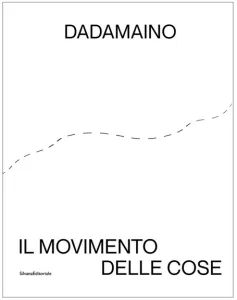
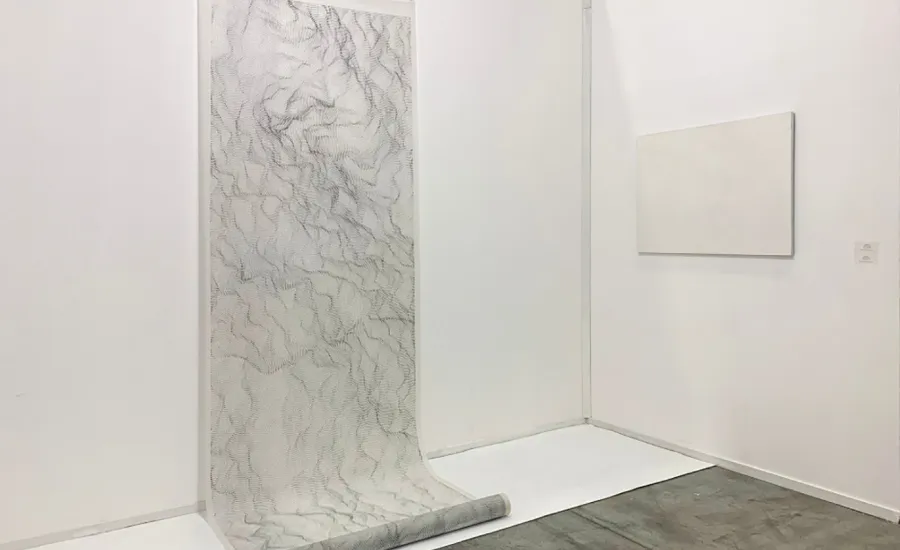
1987 saw the artist start work on the series entitled Il movimento delle cose [The Movement of Things], for which she used sheets of transparent plastic (polyester), at times long and narrow, tending to curl in space, at others set on stretchers, which she exhibited in a solo show at the Galerie Beatrix Wilhelm in Stuttgart. In 1990, this series was exhibited in an evocative environmental installation at the Venice Biennale. That year saw a major solo show at Studio Dabbeni in Lugano and the publication of the monograph Dadamaino by Elena Pontiggia.
In 1993, the artist held solo shows at the Casa del Mantegna in Mantua and the Stiftung für Konkrete Kunst in Reutlingen. In 1996, she began the Sein und Zeit series: while working in the same way, the artist no longer mounted the works, but hung them 20 cm away from the wall to exalt their transparency. That same year, an exhibition was dedicated to her work at the Stiftung für Konstruktive und Konkrete Kunst in Zurich; in 2000, the Bochum Museum presented a broad anthological show, with a monographic catalogue curated by Francesco Tedeschi.
In the 2000s, the artist enjoyed progressive and constant public recognition for her role as a protagonist of Italian art from the 1960s to the 1990s, with increasing numbers of exhibitions and publications.