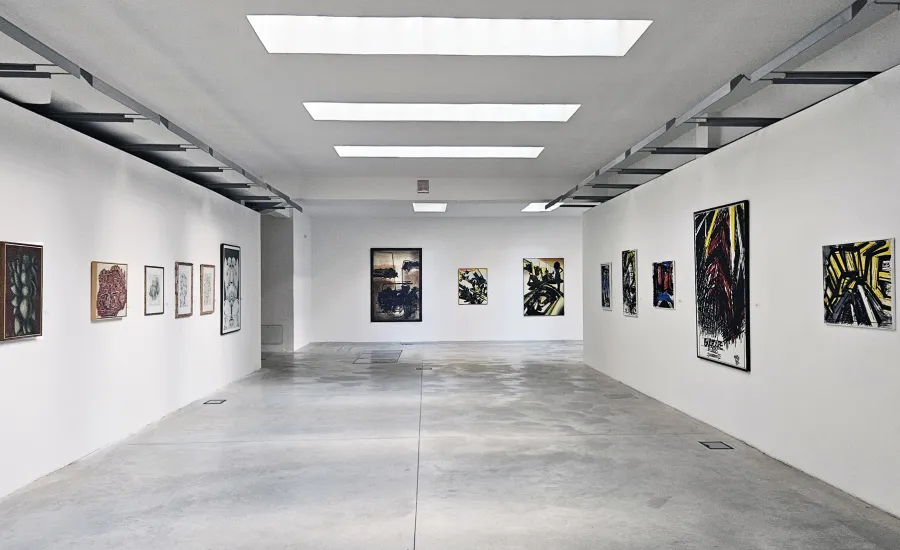
Vinicio Berti was one of the leading exponents of abstractionism on the Italian scene. He made his debut in the early 1940s with artworks of a realist-expressionist nature, which in their approach to the popular world and the dramatic reality of war expressed a categorical break with the Florentine painting tradition, especially post-Rosai. In 1945, together with some friends, including the sculptor Berto Lardera and the painter Bruno Brunetti, he founded the newspaper “Torrente”, which expressed the rejection of an intimist vision of art in the name of direct participation in the tensions of contemporary reality.
Berti was one of the protagonists of the “Arte d'oggi” movement, which for some years brought together important Italian and foreign artists of the time under the banner of a common innovative conviction, organizing three major exhibitions in Florence from 1947 to 1949. Berti came to abstract painting in 1947, after an initial period of reinterpretation of Cubism and Futurism (1945/1947), he continued along the path of the historical avant-gardes (in particular following the line of Mondrian, Malevic and Magnelli), forcefully inserting himself into the general renewal of European artistic culture. Thus arriving, with artworks such as Composizione verticale [Vertical Composition] or Simbolo [Symbol], at the formulation of what he called “a new classicism”, in opposition to all the classical traditions still present in contemporary art, together with other Tuscan painters close to him in terms of training ideas and aesthetic convictions. Together with Bruno Brunetti, Alvaro Monnini, Gualtiero Nativi and Mario Nuti, he founded the “Classical Abstractionism” group, followed by various group exhibitions and at the end of the albeit brief season of the '47/'50 group, he united his aesthetic and cultural positions in a Manifesto.
The group set out to initiate a new cycle in contemporary art with the end of the destruction of form initiated by Wols and Fautrier in order to re-propose, through a language anchored in history and capable of representing the times, a rational and constructive narrative on the thread of an internal vision of matter. Having broken up the group, Berti continued to develop and expand the expressive possibilities of Classical Abstractionism in content and form. The rigorous structure of a classical geometry, expressed between 1947 and 1950, continued to sustain the artworks of those years, from the cycle of Cittadelle ostili [Hostile Citadels] (1955-56), preceded in the phase Berti himself defined as Expansion of Classical Abstractionism (1951-55), characterized by a freer handwriting and greater evidence of connections between lines and planes of color. This was followed by the Omaggio a Einstein [Homage to Einstein], a sort of journey into space-time relativism; there followed the cycles of the Brecce nel tempo [Breaches in Time] (1955-58) and the Avventuroso astrale [Astral Adventurous] (1959-65), inspired by the first space exploits with the important work of 1963 - Utopia del tempo H3 [Utopia of Time H3], winner of Il Fiorino prize - emblematic of Berti's entire conception of man aware of his immense expansive capacities.
From 1966 it was the turn of the Cittadelle di resistenza [Citadels of Resistance], Partenza zero [Zero Departure], Geometria volumetrica [Volumetric Geometry], Realtà antagonista [Antagonistic Reality], up to the works entitled Dal basso in alto [From bottom to top] (1981), a prelude to the more recent Visioni verso l'alto [Upward Visions], which represent the extreme phase of the development of classical abstraction in the confrontation with the incessant becoming of contemporary reality.
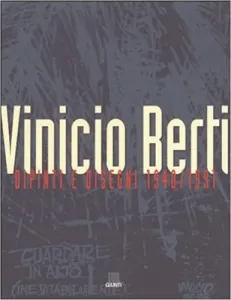
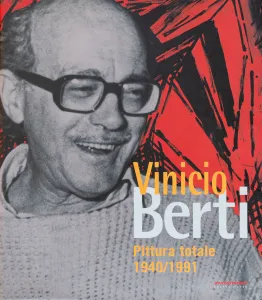
In 2000, the Centro d'Arte Spaziotempo dedicated the retrospective exhibition Dipinti e disegni 1940/1991 [Paintings and drawings 1940/1991] to him, accompanied by a monograph published by Giunti. In 2003 he was the protagonist of two other important anthological exhibitions in Florence – at Sala d'Armi in Palazzo Vecchio - and in Milan – at the Museo della Permanente - Pittura totale 1940-1991 [Total Painting 1940/1991].
Berti was one of the greatest protagonists of Italian art and his works bear within them the high mark of love for life. Believing that, sooner or later, the whole of society could change was the strong credo of Berti's thinking. His artworks, despite the harsh reminder of reality, bear the sign of hope and were a stimulus for many artists who worked with commitment in the second half of the 20th century.